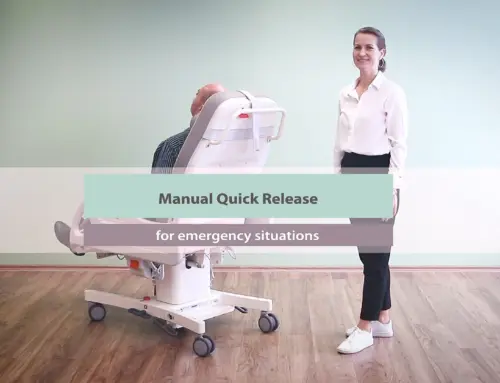
In clinical environments like dialysis units or infusion centers, emergencies can happen without warning. One common question raised by healthcare teams is whether cardiopulmonary resuscitation (CPR) — more specifically, chest compressions — can be successfully performed on a patient sitting in a therapy chair.
What the Guidelines Say
The European Resuscitation Council (ERC) Guidelines provide clear rules for resuscitation in special circumstances, including complex environments such as dialysis units. However, there is still no explicit instruction in the current ERC recommendations on how to perform chest compressions on a patient seated in a therapy chair.
Interestingly, clues can be found in a different context — the ERC section addressing dental surgeries. The advice there is pragmatic:
-
Recline the chair into a fully horizontal position.
-
Stabilize the backrest with a stool if necessary.
-
Begin chest compressions once the patient is lying flat.
This ensures an adequate platform for effective compressions and chest recoil.
The Practical Challenge
In real-world dialysis or therapy settings, reclining a chair fully flat may take too long in an emergency. Equipment, tubing connections, or the chair’s design may limit rapid repositioning. Hence, medical teams often rely on therapy chairs with reinforced stability capable of supporting immediate CPR.
Since stability levels vary across chair models, the most practical approach is simulation-based evaluation using advanced CPR training mannequins that measure compression quality and depth. These real-life trials can help verify which chairs provide a safe and stable surface for chest compressions.
Staying on the Safe Side
Until specific evidence or standardized tests are published, healthcare professionals should adhere strictly to the ERC’s official recommendations. Effective CPR depends not only on prompt recognition and intervention but also on performing compressions under conditions that ensure both patient safety and compression effectiveness.
References:
-
European Resuscitation Council Guidelines 2021 – Cardiac arrest in special circumstances.
-
Soar J, et al. European Resuscitation Council Guidelines for Resuscitation 2021: Adult advanced life support. Resuscitation. 2021;161:115–151.
-
Perkins GD, et al. European Resuscitation Council Guidelines 2021 – Executive Summary. Resuscitation. 2021;161:1–60.