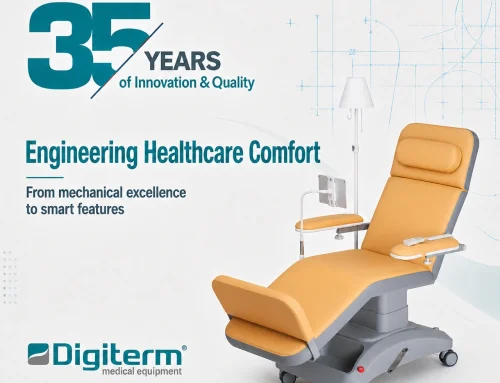
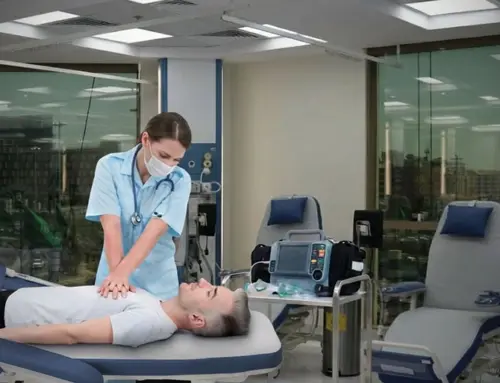
Attention! Resuscitation in the treatment chair may only be initiated in accordance with the guidelines of the European Resuscitation Council. The effectiveness of chest compressions can be enhanced by utilising a stool to provide support for the backrest.
Emergencies in dialysis or infusion units often pose one critical challenge – performing CPR effectively and quickly on patients seated in therapy chairs. Every second’s delay before initiating chest compressions reduces survival chances, making equipment design a crucial factor in emergency care.
Understanding the Guideline
The European Resuscitation Council (ERC) emphasizes that when cardiac arrest occurs in a seated patient, the priority is to recline the backrest into a fully horizontal position before starting chest compressions. This allows for proper depth and recoil during CPR, essential to maintaining coronary and cerebral perfusion.
However, relying solely on electronic actuators to move the chair can take too long. Recognizing this timing issue, clinical teams have been searching for a faster and safer solution.
Introducing Digiterm’s Manual Quick Release
Digiterm has developed the Manual Quick Release (MQR) – a mechanical innovation designed specifically for medical emergencies.
The MQR enables caregivers to instantly disconnect the electronic actuator from the backrest and manually move the chair to a horizontal position in seconds. The mechanism is designed with safety in mind: it prevents accidental free fall, meaning caregivers can easily control the movement without supporting the patient’s full weight.
Efficiency Without Compromise
Unlike some competing mechanical release systems, Digiterm’s MQR has a significant operational advantage: once the backrest is returned to an upright position, the actuator automatically re-engages. There’s no need for technician intervention or recalibration. After the event, the chair resumes full normal operation – ready for the next therapy session.
This combination of speed, safety, and reliability supports emergency readiness in environments where seconds truly count.
References
-
European Resuscitation Council Guidelines 2025 – Resuscitation in Special Circumstances, European Resuscitation Council, Rotterdam, 2025.
-
Soar J, et al. European Resuscitation Council Guidelines for Resuscitation 2021: Adult advanced life support. Resuscitation. 2021;161:115–151.
-
Perkins GD, et al. European Resuscitation Council Guidelines 2021 – Executive Summary. Resuscitation. 2021;161:1–60.